Campfire
…or the place where we get together, to tell our story
“We are the "keepers of the flame" in disseminating tried-and-true ideas and practices (…) - a role that has the effect of structuring, stabilizing, and institutionalizing knowledge“
[83, p. 19]

A theory is dependent on its (inter-, trans-, multi-, post-)disciplinary teachers and practitioners, keeping its story alive and in motion, making it available for falsification and thereby testing its truthlikeness [48].
Due to its speculative nature, The Carrier Bag Theory of Computing is one that needs to be tried and tested in the community, in constructing novel (non-)technological solutions, revisiting education and scientific institutions, especially when it comes to its constructive power.
Collaboration in a Hyperlinked Internet
We suggested an interlinked/interwoven net of thoughts as a potential format as a campfire-like gathering point to counteract the linear (and thereby heroic) telling of a story of computing and instead showcases the different branches ideas and stories can take and have taken. Additionally, it showcases the historically most relevant form of a carrier of collective thought in computing: the hyperlinked internet.
“Open collaboration communities, including expert-driven projects such as
the FLOSS (Free/Libre/Open Source Software) movement, as well as nonexpert-driven projects such as those developed by Wikimedia, are often more
successful in the open capitalist market than their commercial counterparts
(Weber 2004; Benkler 2011).”
[84, p. 85]
What makes its most prominent example,
Wikipedia, “the largest collaborative movement of humankind” [84, p. 85] work and what makes it so successful?
Liquid collaboration as a concept of “short-term fragile interactions, and non-personal and transient cooperation allows collaboration without any direct interactions” [84, p. 85]. The editors of Wikipedia are highly diverse in their identities, motivations and goals, however are “loosely knitted together by technological structures” [85, as cited in 84] as well as by peer control and organisational surveillance [84].
However, in order to keep the campfire not only alive but lively and heart-warming, it is in need of certain care practices. E.g. caring for the time people spend on editing and generating Wikipedia content, establishing collective norms and preventing any ant-designs, that disrupt existing care practices [86].
„When we discuss caring about time, we do not necessarily mean that people are looking for efficiency. Rather, they may be looking for ‘time well spent’. In the context of Wikipedia, this can mean spending time working on a topic of interest, having edits accepted and therefore feeling a sense of accomplishment.“ [86, p. 80]
Visions for a Sustain-able Campfire
To account for the decennial perspective, we suggest a long-term vision of this artifact: building a community-wide wiki that offers methodological, pedagogical and conceptual resources towards a carrier bag approach to computing and forms a network with other critical, particularly feminist intersectional projects (such as, for instance, Full Stack Feminism).
We indent to not just offer a pre-selection of already existing projects and approaches, but aim to sling a wider net: By opening up the carrier bag for contributions and exchange, knowledges and perspectives can roam the network freely and find interested ears and hands. Showcasing different kinds of ideas – stories, experiences, resources, theories, and much more – a collective and interactive carrier bag comes to life. Using a network, we aim to highlight the interconnectedness of the thoughts and ideas surrounding computing, which find a place at our digital campfire.
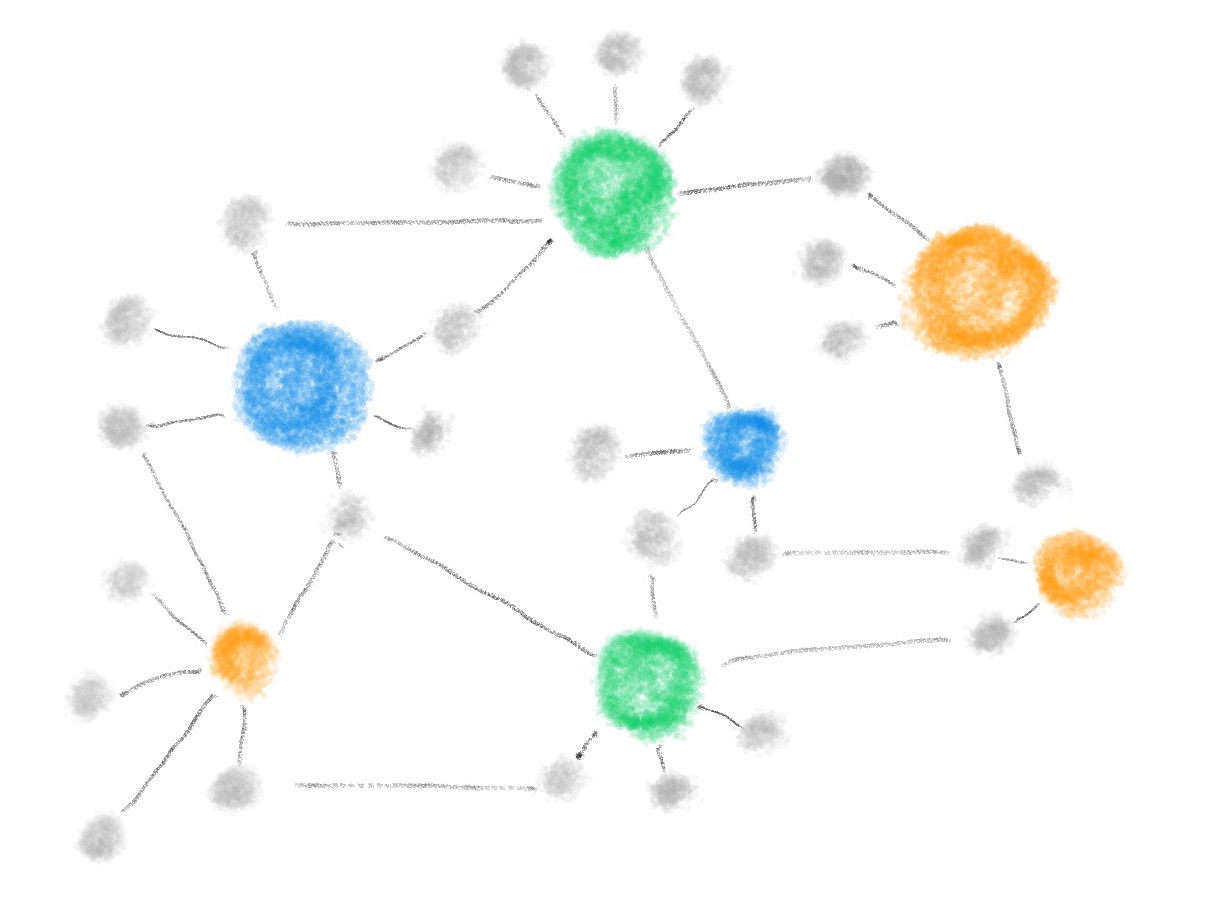
With this, the invitation to join the campfire explicitly goes beyond the traditional gathering spaces of computer scientists. And to keep the fire going, the premise in this story circle should be asking questions - moving away from the known “more of a comment than a question” monologues. Following the idea of commoning to loosen computing from market interests, this exchange can be guiding by building and caring for social relations, acts of provisioning, and forms of peer governance [87], to work towards a minor computing. The proposed graphical representation allows for tracing back the becoming of a community, highlighting influencing and central themes over time.
The Sparks of Minor Computing
At the campfire, exchange between carrier bags and their carriers can create new sparks where ideas and perspectives meet. To keep the fire lit and spark more flames, we actively encourage different forms of participation and activities:
Workshop formats at respective conferences in the computing community (e.g. ACM FAccT, ACM CHI, ACM DIS, …) could introduce computing scholars to the campfire circle and equip them with a carrier bag by guiding and facilitating the first points of exchange across disciplinary borders.
Through blog-like entries into the network, we specifically invite in the stories of those voices which have been kept quiet in the killer story of computing. These contributions can range from personal anecdotes, to research insights from intersectional perspectives on computing, and wishes and plans for a minor computing. Similarly, areas for forums and pinboards can allow for practices of caring by supporting community needs or reaching out for help.
Moving from the digital campfire back onto the paths of our journey, we hope that the interactions within the network lead to an “exchange program” for the custodians, intermediaries, and interpreters of computing. Here, the aspect of collaborative teaching comes into play as well, as teaching offers, materials, and approaches can be shared and exchanged.
Carrying a spark to the current institutions and practices within academia, we aim to encourage reflection in the area of (conference or journal) review processes as well: A carrier bag approach can add new perspectives on what qualifies as a contribution and might open up decision-making in favour of unconventional approaches and unusual questions.
A First Spark ✨
In this carrier bag build up from the first threads we have discussed, connected, and gathered ideas for a minor trajectory of computing, made up of ties and knots. During this process, we have drawn on three questions to guide our thinking, which turned into the red thread of this artifact.
By taking the time to consider our perspectives, we want to invite you - who is now part of the assemblage surrounding this network of thoughts - to take a moment to also consider these questions and to join us at the campfire:
What would it mean, from your perspective and field, to approach computing from a carrier bag perspective?
What kind of premises does this require and what kind of changes would be needed (methodically, theoretically, design-wise)?
What are the tools that would support a carrier bag theory of computing? What would be in the bag?
Threads Mentioned on this Page: