Crisis
Attesting a Status of Crisis
The attribution of a state of crisis is a diagnosis that wants to be avoided in most cases. It goes hand in hand with the postulation of exceptional situations that require special, usually rapid and targeted action.
At the same time, we would like to take this opportunity to point out the possibility of describing moments of crisis as moments of critical juncture, which in turn offer the potential to rethink the status quo and the prevailing path dependencies in order to break away from them.
Having its epistemological background in historical institutionalism, critical junctures define brief moments in history, situations, as “brief phases of institutional flux (…) during which more dramatic change is possible.” [14, p. 341]. Consequently, decisions made in those situations driven by momentous power have a lasting legacy [15]. Thereby, critical junctures, also referred to as “turning points” or “unsettled times” [14, p. 341], might be the starting point for new developments and in consequence new path dependencies, not only for (political) institutions, highlighting the transformative power of crises.¹
Critical Junctures Resulting from Digitalisation
Progressive digitalisation has repeatedly led to moments of critical junctures in various domains, within which established practices, social structures and mechanisms have been challenged – sometimes triggering or exacerbating crises.
One example in which the transformative power of digitalisation is most prominent in challenging well-established value systems is the platformization which Uhlmann et al. [16] phrase as a critical juncture of media structures. As online journalism is undergoing multiple crises which are associated with the rise of big tech platforms and their power to shape the Internet’s infrastructure, interaction paradigms and economic mechanisms, online media are increasingly adhering to the goals and logics of the big tech companies’ platforms [16].
However in its reframing as a critical juncture, it also holds innovative potential as it challenges the niche actors of this field, in this case journalistic start-ups, to react to the critical juncture with, for example, new fair price models or technological solutions for social challenges as Uhlmann et al. [16] analysed.
Another timely example of a critical juncture is the rise and dissemination of generative AI (GenAI) and the resulting shift of focus in computing since the release of ChatGPT at the end of 2022.² In the column section of the Communications of ACM magazine, Moshe Y. Vardi [2024] is asking “Is Computing a Discipline in Crises”? As the main argument of his opinion piece, the author points out how AI as a former subfield of computing seemingly becomes the major concern of the discipline and center of attention, whilst the discourse on it is still wildly scattered and also separated from a discussion of the social and societal implications [17].
„The AI community is badly fragmented, which makes it quite challenging to agree on collective actions. Hence the sense of crisis.“ [17, p. 1]
This is prominent in examples such as the absence of mitigation and investigation of AI risks in the “mainstream” research programs of some of the main conferences such as NeurIPS, as Vardi [2024] argues.³ Here, too, Vardi [2024] is critiquing how big tech companies consisting of the known six corporations are setting the tone for AI, since they have not only the infrastructural power, but also capacity to have an influential say in the debate. Vardi [2024] claims that we are in need of more social responsibility and “community-wide conversations about the future of AI” [17, p. 1]. These are, of course, hard to have if AI is becoming increasingly monopolised and primarily dependent on the capital and interests of mega-corporations.
What both situations caused by computing technology, and to which we refer as critical junctures have in common, is, that both examples show a connection to the phenomenon of the killer story, as well as the dominance of one technology or ideology connected to one (or few) actor(s).⁴
Power to the Marginalised - Niche Actors Challenging the Existing Socio-Technical Regimes
Pointing back at the transformative power of crises, it should be emphasised that marginalised groups, in the sense of technological transitions of so-called niche actors [18], might use those situations of unsettledness for real-life experimentation and implementation of small utopias: The goal is showing possible paths and opportunities for re-invention as well as detecting possible obstacles for the establishment of alternating futures.
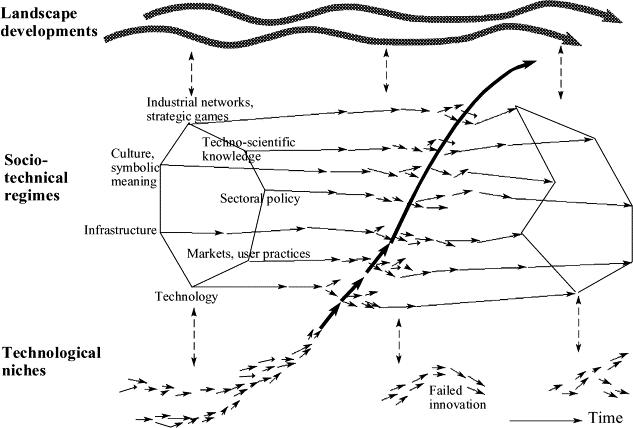
As Siapera et al. [2015] formulate it, those niche actors use their actions as critique of the socio-technical regime to challenge the status quo and create possibilities for renewal. This goes hand in hand with the formulation of a Carrier Bag Theory of Computing, which hopefully opens doors for marginalised voices to be heard, and unfold their (trans-)formative power.⁵
The transformative power is particularly imminent in indeterminate situations affording the establishment of new routines and thereby opens opportunities for experimental practices and new imaginations. This does not only involve changes in technology, but also changes in user practices, regulation, industrial networks, infrastructure, and symbolic meaning or culture [18].
Of course, indeterminacy and forceful disruption of situations is also the modus operandi of the Silicon Valley, embodied in the mantra “move fast and break things”. Disruptions and destabilisations therefore are spaces not only for productive critical junctures but also openings for further exploitation and extraction. A critical juncture thus by definition is an ambiguous moment - things could go either of the multiple ways. It is important to understand the potential germane to such moments, but no less (and perhaps even more) important are the ethico-political (and therefore also epistemic and situated) perspectives from which such junctures are acted upon. Construction of alternatives at the moments of crisis thus will depend on the situated, embodied and embedded positioning of those groups and actors who take part in them.
¹ In line with the expression “May you live in interesting times.” understood as a curse, critical junctures are trouble and opportunity at the same time, requiring responsibility and moral judgements of those involved to bring about a world in which we can live well in mundane times.
² Not only is GenAI turning into computing’s sole focus, it also presents a critical juncture for search and knowledge dissemination, as posited by Collin Jennings essay “A linkless internet.” Returning to an image of an all-knowing narrator, AI-generated answers to search requests push out hyperlinked search.
³ Certainly, there are interdisicplinary conferences that are wholly or partly dedicated to investigation of risks and consequences, including “Fairness, Accountability, and Transparency” (FAccT), and others. At the same time, this also present a curious phenomenon the carrier bag theory aims to address: Whilst research on the risks and implications of artificial intelligence definitely exist, there seems to be a disciplinary (and even spatial) divide in where these different aspects of AI are discussed. Both conferences and publication venues from HCI, and social sciences and the humanities focus for example on the impacts of AI or more specifically video games and mental health, but the communities of scholars barely overlap. Of course, there are many social sciences and humanities scholars in “society-facing” disciplines of computing, including HCI, however the reverse is not the case nearly as often as we wish it would be. This then prompts questions about who is willing to learn whose vocabulary, whose knowledge gets to be the base and whose - the parts that need “integrating” (read: translated into dominant discipline’s terms). See more in [173].
⁴ Additionally, another dominant narrative surrounding AI is one of maximising not only profit, but also individual productivity, thus tying into the individualistic hero-cult of killer stories.
⁵ This transformative power of crises could then also allow small local solutions fitting the contexts and everyday-decisions faced by the those affected by the crisis or technological change.
Threads Mentioned on this Page: