Community Approaches
When offering a carrier bag theory of computing, we aim to consciously invite in the material, mundane, and embodied. Hereby, a carrier bag approach is supposed to stand in stark contrast to the Californian Ideology’s rejection of community and social progress. In the following, we want to offer some approaches that could be stored in the carrier bag of computing:
Feminist Ethics of Care
When thinking about ethics and morality, we think about big questions, dilemmas, and conforming to a certain set of standards or norms [88], therefore focusing on “killer and hero questions.” Following the aim of the carrier bag to bring mundane perspectives into computing, we are drawing on Tronto’s [1998] notion of an ethics of care, which includes the everyday judgements in care activities. Tronto and Fischer [1990] conceptualise caring as follows:
“[…] caring [can] be viewed as a species activity that includes everything that we do to maintain, continue, and repair our “world” so that we can live in it as well as possible. That world includes out bodies, our selves, and our environment, all of which we seek to interweave in a complex, life-sustaining web.” [89, p. 40]
Conceptualising care as both a mental disposition of and actions resulting from concern includes care as action and practices - not a set of rules - being based on flexible standards [88].¹
Mirroring the gendered notions of computing and software, care is currently undervalued due to its prescription as a “women’s profession” associated with lower wages, separated from the public sphere and supposed to be done in private [88]. A change in how care would be valued in the world, would then also change the organisation of the world [88].
Developed by Tronto and Fischer [1990], Tronto [1998] introduces four cyclical phases of care:
- Caring about includes the process of becoming aware and paying attention to caring needs both in terms of listening to articulated needs and recognising unspoken needs [88].
- Caring for focuses on assuming serious responsibility to meet an identified need [88].
- Caregiving then describes the material processes to meet the caring need, it includes the performance of the caring tasks and the knowledge on how to execute them [88].
- Care receiving then is the response of the thing / person / group to receiving caregiving. In this process responsiveness as a moral element is shared between the care receiver and caregiver [88].
How does care - and an ethics of care - then relate to the carrier bag theory of computing and our campfire? A feminist ethics of care approach can offer insights into computing from multiple perspectives without the need for killer stories:
🌍 Caring - understood as living well and maintaining the world that allows for living well [88] - changes with context, as living well might mean different things are needed to achieve this state. In the context of computing, this might include aiming to understand a lack of diversity in informatics departments (including researchers, teachers, students, and administrators) and meeting the needs of these groups (i.e. eliminating causes for inequalities). Following Draude [2023], implementing an ethics of care approach in informatics in connection with foregrounding diverse perspectives, might spark questions such as:
“How do guidelines really become part of the disciplinary culture in informatics research, development and education – not just on paper but as a lived practice? Who cares for diversity issues and why? Who does the work? Who cares about the concepts used? Who cares about educating themselves and others about basic concepts such as diversity and intersectionality in relation to informatics? How can this caring for diversity work be supported structurally? Are resources, capacities and attention redistributed accordingly?” [90, p. 26]
🗡️ In contrast to the killer and hero stories of computing, that the discipline and industry has told so far, a feminist ethics of care puts a focus on the decisions of the everyday and additionally highlights the aspect of life currently supposed to be hidden in the private sphere, away from the public eye [88]. With this, it invites in a materiality that comes with care and caring as well through e.g. technology assisting in caregiving, and helps examining the interaction between humans and non-humans in caregiving [91, 7].
Nevertheless, similar to the individualistic hero of the killer stories, the ubiquity of care is often unacknowledged as the dominant “model of man” paints people as autonomous actors, and vulnerability as a weakness attached to certain groups, so the majority can keep up their myth of invulnerable autonomy [88] - a hero story in itself. A feminist ethics of care approach can then offer a way to accept vulnerabilities, community, care, responsibility, and relationships:
“Embracing care as a part of human life, recognising its role in creating interconnections and relationships of receiving and giving over a lifetime, may provide us with a way to rethink some of the ways in which we now seem unable to cope with human vulnerability.” [88]
A “feminist ethics of care” patch on the carrier bag theory of computing highlights the interconnections and relationships emerging when engaging with computing technologies. These technologies should not continue being the sword of the individual hero, but help to meet the needs of people in living well.
⚙️ In a more concrete manner, a feminist ethics of care approach puts a responsibility on informatics scholars and practitioners alike. Caring requires attentiveness, responsibility, competence, and responsiveness. It requires know-how, judgement, rational explications of needs, and sympathetic appreciations of emotion [88]. For those engaged with computing, this means moving away from technological determinism and solutionism, and instead listen first and implement later. Most fundamentally, an ethics of care approach requires the “full story” [88], which means hearing and acknowledging all the voices engaged in caring instead of offering a paternalistic or authoritative solution. That context should be fundamental when engaging with computing technologies, as well as the voices of those developing and those using the technology, but also should consider the world around it, such as environmental concerns. Computing scholars have to care for the users of their technology, as well as the technology itself. It means considering the needs of the users of a computational technology, the needs of the group a technology is administered to (for example in the case of a credit scoring algorithm), and it requires considering the needs of the technology itself such as in the form of data curation and management [92, 68]. A feminist ethics of care allows a lens for analysing one’s own care activities and the role of caring in the world [88] and therefore also the place caring should take in computing industries and education.
Social Commoning
Currently, computing as an industry and education can be argued to be fully situated in the for-profit paradigm of capitalism - a system which foregrounds killer stories, individualism, and profitability. In Neoliberalism, the market seems to be the only legitimate sphere. And this seems to be echoed by Hardin’s [1968] “The Tragedy of the Commons” as well: When people have open access to resources, chaos, ruin, and failure will follow [94].
But one flaw of Hardin’s parable can be already found in the premise of the tragedy: The pasture in the story is a free-for-all without regulations, which does not represent commons [94, 95]. Instead commons are social systems for collectively addressing a groups problems through the mundane realities of self-organisation [87].
One of the most notable names when it comes to the study of the common pool resources as a form of economic governance is Noble Prize Winner Prof. Elinor Ostrom, introducing for example variables that could indicate the likelihood of success for self-organising processes.

THE COMMONS:
→ a social system for the stewardship of resources based on shared values and community identity
→ a self-organised systems with limited reliance or market or state
→ wealth that is inherited, created collectively, and passed on, including natural resources, civic infrastructure, cultural artifacts, traditions, and knowledge
→ not a resources, but a resources + a community + shared protocols, values, and norms
[95]
Accordingly commons don’t just exists as a natural resource, but require the social practices of commoning as well. For these practices, Bollier and Helfrich [2019] introduce a framework “based on the premise that commoning is primarily about creating and maintaining relationships - among people in small and big communities and networks, between humans and the nonhuman world, and between us and past and future generations” [87]. Their triad of commons includes the components of social life, peer governance, and provisioning
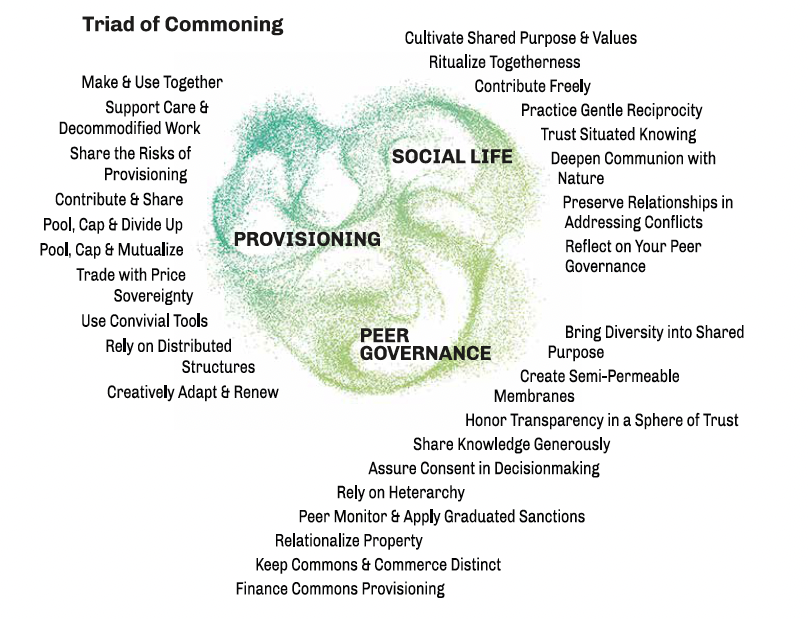
Build on ideas of subjectivity, relationality, and language, the authors aim to introduce new ways to engage with values and highlight the social dimensions of the commons [87].
The practices of commoning can in turn be related to an ethics of care again. Commoning, understood as situated practices, includes the inderpendency of humans and non-humans, representing relations between communities. Building on the notion of care, these communities are “worked out according to and across a variety of different needs and interests” [96]. Care thus shifts the focus of commoning to an activity done well, instead of relying on the quantification of output [96]. According to Bresnihan [2016]:
“It is precisely the social and material interdependency of the commons that requires practices of mutualism and reciprocity. Rather than breaking the world up into discrete parcels and units for individuals to exclusively own or manage, practices of mutualism and reciprocity are based on a recognition of limits and the need for cooperation.” [96, p. 100]
Coming back to the carrier bag approach proposed here, social commoning can offer an approach to computing based on self-governance and care moving away from the practices of the profit-driven tech industry. It allows for situated knowing, support, and care, as well as peer monitoring. Commoning could offer a community approach to computing, in which knowledge is freely shared as diverse communities work in collaborative networks.
Playful Engagement
As a parallel approach of interaction with computational artifacts - and software specifically - Miguel Sicart conceptualises play as a mode of engagement with software that establishes a relation with the processes, rules, and agencies of software not based on productivity but pleasure [97, 98]. Focusing on exploration, play helps to create new relations with and through the formal rules of software and the world emerging from it. In turn, it “modulates form of human and computational” [97]. This playful engagement with software highlights one parallel approach of understanding the interaction between computational artifacts and their users.
Collecting Community Approaches
The approaches described here only present a starting point on ways to engage with computing from different perspectives. With this critique, we don’t want to just offer a stable artifact but a living network of experiences, stories, and resources.
¹ With a focus on “species activity” [88], the ethics of care - even though focusing on things and environments as well - can be read as more so anthropocentric. The carrier bag theory of computing additionally aims to include non-humans and more-than-humans in its ethics of care.