Theory of
Theory is…
“…a statement of concepts and their interrelationships that shows how and/or why a phenomenon occurs.“ [43]
A theory is a carrier bag in itself: It needs to be filled with either laws, hypotheses, descriptions and/or facts to not leave it a hollow object with no meaning. Theories are needed to further a discipline, prevent repetition, and offer novel views on the phenomena it addresses. Theories need to be disputable and defensible, otherwise they run the risk of cramming everything into one bag.
However, can a theory also be formulated to foster persistence, circularity, sustainability and advocate for social justice? What theories are needed in the discipline of HCI?
Historical Accounts of Theory in HCI
As HCI emerged as a discipline in its own right, questions of knowledge transfer from other disciplines have continuously been imminent: how can methods and theories of other fields be adopted to inform the design of technology for human use?
Beginning in the early 1980s, theories from cognitive psychology, mostly basic research, were broadly referenced and transferred onto the analysis of humans interacting with computers [44], e.g. resulting in the development of the well-known GOMS (goals, operators, methods and selection rules) model.
In the late 80s, HCI research moved away from the adoption of cognitive theories as the central theoretical trend, since the translation of concepts and research results was not working as seamlessly as expected, which resulted in exploring other disciplines, as for example Activity theory. In the 90s, a ‘turn to the social’ was attested to the discipline of HCI, focusing on contextualisation and turning to the work of sociologists, anthropologists, and other social sciences, most prominently introducing situated action and ethnography as methodological and theoretical branches to HCI [44].
Other prominent theories include self-determination theory, generative theories of interaction, distributed cognition, external cognition, feminist theories, behaviour change theory, flow theory, somaaesthetic design, theory of planned behavior, and critical race theory, to mention just a few.
„Interestingly, the vast majority of these theories have their roots outside of HCI, such as applied perception, motor learning, distributed cognition, ecological psychology, ethnomethodology, and activity theory.“ [45, p.6]
Among other things, this results in the danger of the marginalisation of theory where methods are borrowed from other disciplines, “to be selectively deployed as needed” [46, p. 544] without the theoretical background being seriously engaged.
Theory Crisis in Human-Computer Interaction
“When Rogers [39] in 2004 took stock of the achievements in HCI research she stated that the field appeared to be in a state of flux; new theories where imported and developed and design practices and technologies where changing at an apparently ever increasing rate. While much has since been achieved within HCI, we appear to be facing roughly the same situation ten years on. While a highly dynamic field is arguably a desirable quality of HCI, it also challenges us to continuously explore the coherence and interplay between theory and practice. If connections between theory and practice are not maintained and re-articulated, the risk is a drift, where theoretical developments are made but these are out of sync with the object of study.” [47, p. 1643]
In HCI, scholars are claiming that the discipline is undergoing a theory crisis. This diagnosis is presented prominently in the last years at disciplinary conferences such as the NordiCHI 2022 in Aarhus and at Mensch und Computer 2024 in Karlsruhe by Kaspar Hornbæk.
In their diagnosis of the crisis in Human-centred Computing, Oulasvirta und Hornbæk [2022] partly blame the over-reliance on iterative thinking, or, as they put it, a mentality of “ratcheting to success”.¹ What fosters this killing mode in design, according to Oulasvirta und Hornbæk [2022], is that „[t]he incentive system is perversely biased for quick wins, asking for iteration and trial and error. The field begs for novelty, innovation, and flash. This renders us to a ‘ratcheting’ mode“ [48, p. 89].
What a Theory Can Do (in Human-centered Computing)
“So how can theory best inform design? Are there other ways of translating theory-based knowledge, besides turning it into guidelines or analytic frameworks that end up having limited utility? […] a quite different perspective on the nature of the relationship between researchers and designers is needed – one which sees them working more as partners collaborating together and engaged in ongoing dialogues […]” [44, p.32]
„A theory can inspire, foster reflection, and help take a new perspective. A theory can describe, explain, and predict interaction beyond intuition and observations (Shneiderman, 1986).“ [48, p. 78]
Beyond, or even due to offering new (ethical and philosophical) perspectives, theories could offer not only problem-solving strategies but also hold transformative capacity. Especially when it comes to the Gestaltung of computing technology.
Theories can help predict and foresee outcomes of behaviour, and understand and explain the mechanisms or the processes involved in behaviour [49]. They can, e.g., be used to generate new technological artefacts based on theoretical foundations [45].
“So instead focus on whys and mechanisms (not just on whether something works).” [49]
Are theories even in line with designerly ways of knowing? It can be argued that theories are not the most effective in guiding a disciplinary direction of a field that is so ‘hands-on’ and is committed to something that can be framed as do-ocracy – the decision as to what works remains. However, this does not mean HCI is not in need of theory. Quite the opposite - we argue that it is highly relevant when it comes to answering the questions of “does it work”, “how does it work,” “why does it work” and “should it work (in a specific way)”.
“The issue of whether something ‘works’ goes beyond questions of technical or practical efficacy to address a host of social, cultural, aesthetic and ethical concerns.” [50, p. 156].
Designing with Theory in Mind
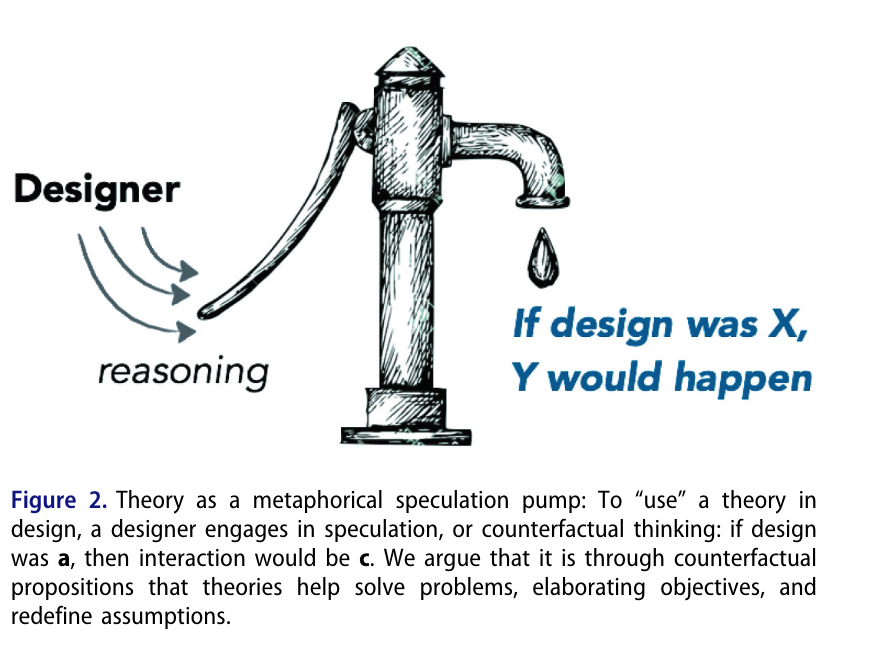
When we focus on a specific sub-discipline of computing, namely the design of computing technology for human use, it is argued that theories should inform design [48] and can do that in multiple different forms. Oulasvirta and Hornbæk [2022] propose the concept of counterfactual thinking (a > c), with “an antecedent (a) and a consequence (c), linked by the counterfactual step” [48, p. 79].
In its core it represents a “what if” thinking, speculating about possible design outcomes that diverge from the status quo and come close to anything that is considered to be ‘good’ [48], without further specification of what this good entails.
Depending on the paradigm in the discipline of Human-Computer Interaction (HCI), ‘good’ might be, for the first wave, stemming from engineering/human factors of efficient task-completion; for the second wave (cognitive turn, work-oriented focus), it could be fitting technologies and their use to the human capacities of the mind; for the third wave (ethnographic, participatory) good might mean a good fit to the respective community and specific context the technology is developed into [48]; for the currently rolling fourth wave of HCI, which turns its focus to entanglement with ubiquitous and ‘intelligent’ technologies [51], as well as politics, ethics, and values, a call and back-draw on theories borrowed from sociology such as Actor-Network-Theory, Agential Realism and normative frameworks is happening.
Last but not least, theory can not only inform design but already contextualise a problem analysis before any prototypes are even drawn up, inspired by theoretical insights. Theories in computing can therefore offer an acceptance of failure and alternative solutions. After all, why shouldn’t “no result is also a result” not apply to computing as well?
Designed Artifacts as Theory on Their Own [50]
Besides the different waves in HCI, there is the conceptualisation of designed artifacts as theories on their own - formed by the designer’s aesthetic accountability [50].
“As decisions combine with one another to form a complete and highly finished design, it is as if an elaborate theory is constructed, embodied by the emerging design, about the important factors and configurations in designing just such a device in just such circumstances, a theory as definite as the physical components used to construct it.”
[50, p. 158]
Thereby design (in HCI) characterises itself (as opposed from science) as “dependent and localised” [50, p. 158], which inevitably results in the need for user-testing, and gathering multiple accounts and perspectives [50]. Through that the “theory” of a design gets tested in reference to the designer’s “aesthetic accountability - the responsibility to make things work” [50, p. 162], producing understanding instead of facts [50]. Additionally, by approaching design artifacts and design itself as a form of research and theory/theory-building, the imaginary of what counts as theory and what form it might take gets challenged and expanded.
Carrier Bag Theory or Approach?
The question then is, whether what is offered here is a theory or perhaps rather an approach - and this is where yet another perspective on “theory” comes in. To have a theory of something, especially in more colloquial terms, also means approaching something from a specific vantage point. Theory can help situate oneself in a disciplinary sense and make explicit the premises that one operates from. Theory here then is an informed explicit approach, a way of seeing, addressing something. The “carrier bag theory of evolution” [2], which inspired LeGuin’s [1989] “Carrier Bag Theory of Fiction”, was conceived by a journalist asking her readers to shift their vantage point and see the narrative of evolution from those who were excluded from telling it. A theory then is ultimately a proposition: ”what if we looked at it this way?”. A Carrier Bag Theory of Computing thus is such a proposition for a different vantage point, a different approach.
¹ With it’s focus on computing technologies, just as with Informatics overall, HCI is also not free of market-capitalistic influences. This could potentially lead to an attitude of performance maximisation and pressure to innovate.