Methodological Implications
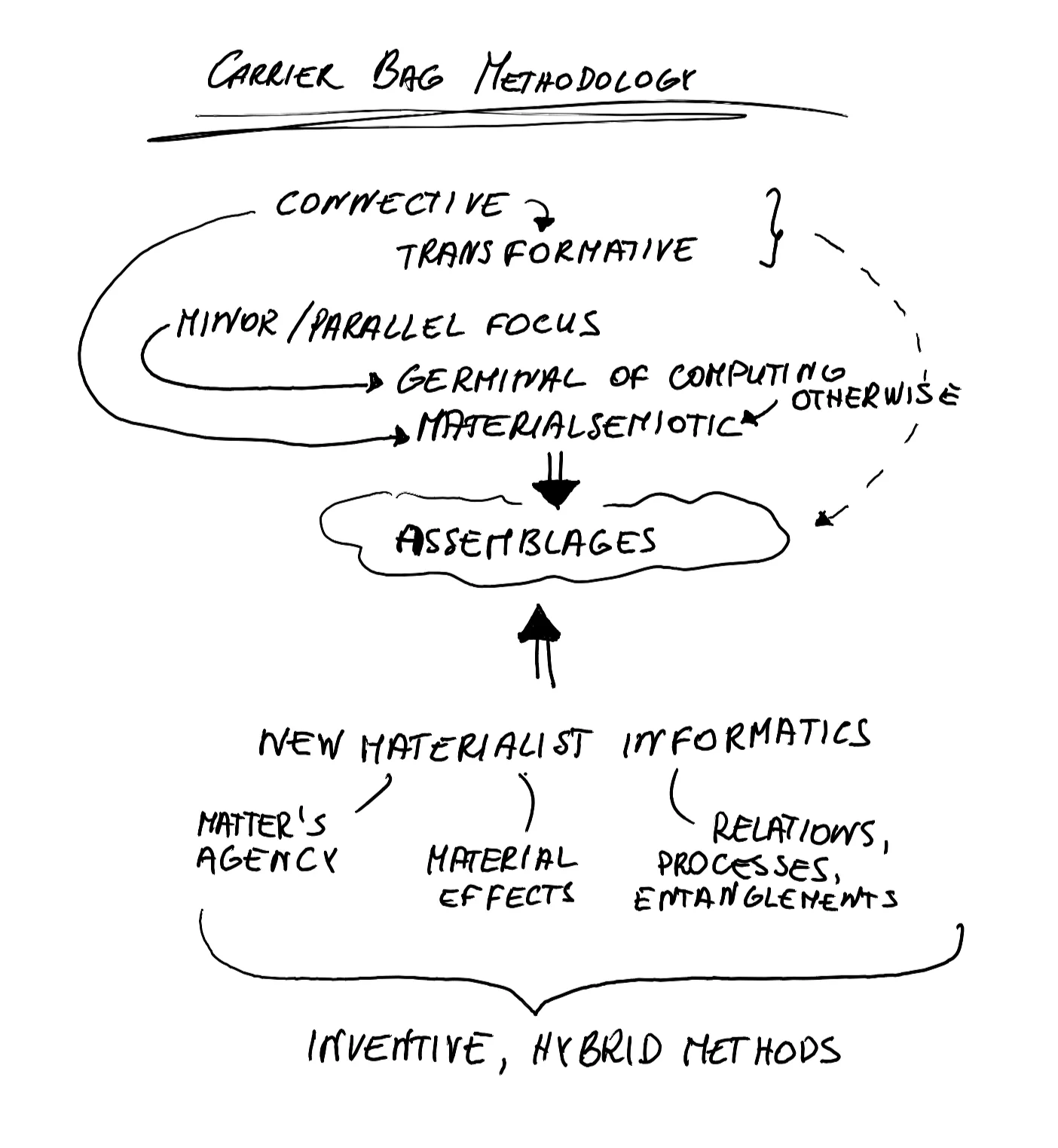
As we have discussed elsewhere, a carrier bag approach to computing, positions it as a connective, communicative discipline that has a tendency to hold many other disciplines and perspectives. As a carrier, it is a field that connects at the same time as it transforms through that connection. Importantly, such a perspective onto computing, drawing from Ursual LeGuin’s germinal essay [1], requires and builds on the minor histories¹ and perspectives in computing: the hidden figures, the underexplored pathways, forgotten techniques and technologies². In other words, this is not a new grand theory of computing, but a parallel plane, intersecting with the mainstream canon but also diverging from it: it is a trajectory for a minor computing (compare it to the star constellations: Ursa Major and Ursa Minor; or with minor and Major tonations in music). Minor refers to not simply “alternative” or “against the grain” but to something that is off-centre, semi-peripheral, tangential, para- and infra-, lateral. This signals proximity but not direct investement in or equivalence to centres of power: it is a divergence. In other words, it signals “lines of flight” [72] – openings that are germinal for computing otherwise.
Conceptually, this means a focus on embodiment, materiality, tangible interactions – the kinds of world-making activities that are neither purely abstract, nor purely discrete, but materialsemiotic. Such a stance, instead of putting informatics or computing in a dichotomous opposition to abstract knowledge, rather insists on the recognition that all knowledge is materially embedded and embodied [73, 74] and that computing technologies, while hiding behind metaphors such as "cloud" and similar disembodied imaginaries, are materially rooted.
Methodologically, this needs to be translated into an integrative approach: computing and computing technology design as capable of taking materialsemiotic concerns into account, including environmental and socio-cultural aspects. If computing is to be seen as a Gestaltungswissenschaft, i.e. a discipline and a praxis that composes, arranges and puts things together, then it unavoidably engages ethico-onto-epistem-ological arrangements. It kneads, weaves, knits and patches together abstract mathematical concepts, formal constructs, hardware solutions, software architectures, databases, culturally-significant categories and meanings, ground truths, and various other materialsemiotic objects all the while infusing them with its own distinct modus operandi.
More concretely, to attend to these arrangements that have ethical, epistemological and ontological consequences, requires a methodoloical toolbox equiped with items that are suitable to grasping materialsemiotic entanglements and their transformations through computing, as well as tools that can activate compositional thinking. Compositional thinking is distinct from computational thinking in that it entails not only decomposition, pattern recognition, abstraction and algorithms (the staples of computational thinking [75, 76] but also resonance, (co-constitutive) relation, and grounding in response-ability (as a capacity to respond to/for the conditions and effects of specific technology).
| Computational Thinking | Compositional Thinking | |
|---|---|---|
| Decomposition | ↔ | Resonance |
| Pattern recognition | ↔ | Co-constitutive (transductive) relation |
| Absraction | ↔ | Grounding in response-ability |
| Algorithms | ↔ | Activation |
One such methodological and theoretical approach would be new materialist informatics [77]. New materialist informatics is a convergent field that brings together new materialist theories together with informatics knowledges and design practices. It is a diffractive meeting point: new materialism and informatics challenge, reorient and productively disrupt each other for new vectors of critical technical practice [78] to emerge. One of those vectors, for instance, forms along the new materialist line of attending to the agencies of matter as well as material effects of technologies that encourages informatics to develop ways to systematically account for such agencies and effects in research and design. Another vector is that of entanglement - it asks informatics to re-think its objects of research as assemblages or arrangements of human and non-human elements, and re-orient its design practices accordingly. This means that what is to be researched and designed is not a specific technology but a set of sociotechnical, materialsemiotic, naturecultural relations. These relations find their temporarily fixed expressions in technical objects and infrastructures but they are ultimately set in specific environments and thus need to always be seen as integral to them. This is not the same as simply accounting for “context”, as if the object and its context are separate, but rather accounting for the object-in-context assemblage. Simlutaneously, if our attention shifts from objects to relations (and processes), then the carrier bag methodological perspective would also mean, as we argue in the informatics education section, that the answer to specific problems sometimes might be not more design or more technology but rather non-design.
While there are meta-methodological theories and approaches that can be useful for new materialist informatics and carrier bag approach to computing, many of them stemming from or inspired by social sciences & humanities (such as process ontologies, post-qualitative research, entanglement HCI, more-than-human design methodologies, soma design, etc.), the actual methods and concrete methodologies for carrier bag approach might have to be invented. As we have argued in our previous work [anonymized] and would like to propose here, a carrier bag approach to computing and design requires profoundly transdisciplinary, hybrid methodologies. Such methodologies are not readily available but have to be created - much like “inventive methods” proposed by Nina Wakeford and Celia Lury [2012], a kind of conceptual creativity and attentiveness to the research assemblages (problem+researcher+context) at hand need to be mobilised.
In order to do that, the creation of hybrid, “third spaces”, where transdisciplinary work can happen through development of common vocabulary and new work practices, is needed. By this we mean not simply interdisciplinary projects, which are quite common in informatics, particularly when the participating disciplines are already proximate (software engineering and machine learning, or informatics and cognitive science, etc.) – carrier bag approach calls for more diversified and “harder” conversations that invite knowledges traditionally excluded or undervalued in informatics research, or knowledges that resist easy formalisation. It is important to ask, we argue, what kind of forms of knowledge and knowledge-making practices can be collaboratively invented when informatics meets humanities and social sciences without the somewhat immediate and often expected resort to default computerisation and digitalisation (expressed through methidolatry and the “hammer approach” where all knowledge is expected to be integrated into the computational methodological fold). Such methodological inventiveness is crucial: not only do we remember Audre Lorde’s [1983] dictum that the “the master’s tools will never dismantle the master’s house”, we also know that methodologies and methods, research in general, are not neutral captures of states of the world but active interventions into the worldmaking processes.
¹ On minor histories and minoritarian versus majoritarian science, see Deleuze, G. and Guattari, F. [1987]. A Thousand Plateaus. Minneapolis: University of Minnesota Press. Also ways of telling other histories present in the works of scholars such as Sadiya Hartman.
²One approach to uncover the forgotten technologies and minor histories can be found in media archaeology. This approach can help to develop an understanding contemporary media through historical media and resists the placement of artifacts in historical contexts. It functions as a critical look on what “problems” media and technology supposedly answer, how is this expressed historically in both their materiality and legitimising discourses, and what ethical implications follow from these. Hereby, media archaeology specifically also draws on science fiction, prototypes and failed technologies, and imaginary media and technologies [81, 82].