Killer Story
Ursula Le Guin [1] describes science fiction as the mythology of technology. It is an undertaking of heroes, “Herculean, Promethean, conceived as triumph” [1]. The stories of technology accordingly follow a type of storytelling associated with dominant ideology. Heroes embarking on journeys driven by their individual skill and prowess.
In the fields of narratology and mythology, the hero’s journey or hero’s quest describes a universal story structure such as this, containing the separation or departure of the hero, the trials and victories, and the hero’s return and reintegration [20]. Here, the hero separates from the ordinary world and descents into a special world full of enemies, tests, and allies, before being rewarded during initiation and returning to the ordinary world [21].
Nevertheless, just like the killer stories of fiction, the hero’s journey is not without critique: Besides being criticised for misinterpreting myths to confirm his hero’s journey, Campbell, the scholar who conceptualised this narrative trajectory, was accused of removing the stories he analysed from their social and cultural context, describing cultural specificity as local masks overlaying universal archetypes [22, p. 136-137].¹ Accordingly, Campbell understood myths as “archetypal dreams, expressions of ageless archetypes” [22, p. 137], and with this disregarded the materiality, subjectivity, and situatedness of myths and stories. Campbell’s view of the myth and hero was therefore a reflection of his own sociopolitical-cultural position, shaped by anglo-western narrative elements and the individual hero-cult [22].
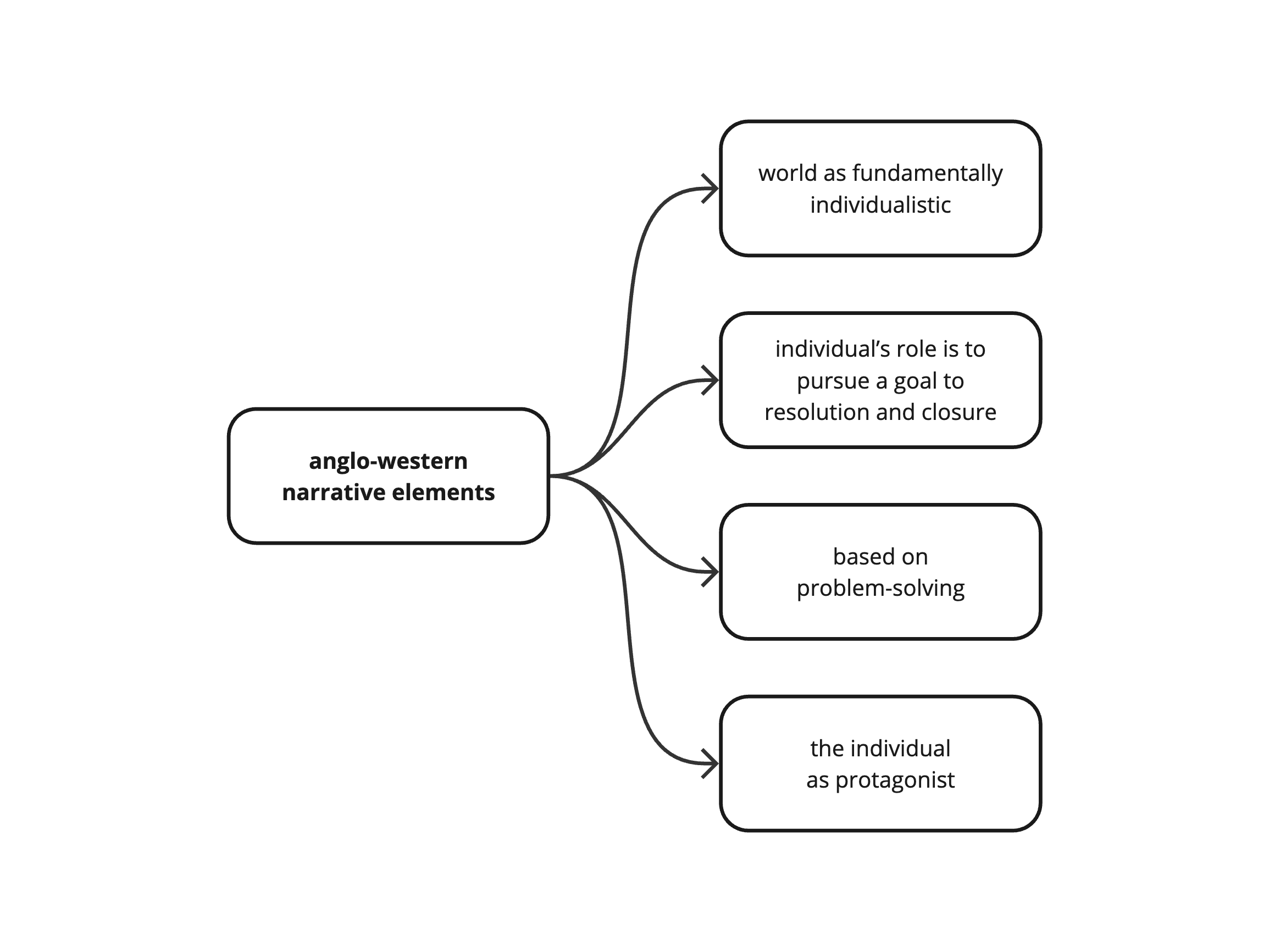
Science fiction often reproduces the individualistic, patriarchal hero’s-journey-structure in their killer stories of technology. Mary Shelley’s “Frankenstein “ (1818) not only introduced some of the archetypes of science fiction, but also presented the first modern critique of patriarchal science [23]. Similarly, the line up of authors in the first science fiction anthologies, painted the picture of the genre as being for “the boys and their toys” [23], shaped by mid-century tone setting of science fiction as sterile, male, and white, based on imperialist and colonial ambitions of settlers and industrialists [23].
This western, white, and male archetype not only applies to earlier science fiction heroes, but can also be observed in the pioneers of computing and the “tech bros” of today.
“This masculine template extends beyond initial funding and seeps into the lived experience of workplace culture itself. Even the language displays an inherently masculine narrative, where companies are often described as "crushing it" or "killing it," with engineers engaging in "hackathons" and "death marches.”” [24]
Introduced by Richard Barbrook and Andy Cameron in 1995 [25], the Californian Ideology describes just this. Made possible by a belief in technological determinism and with a push for economic liberalism, the rugged individualists of “macho sci-fi novelists” became reality [25]. As a mix of “cybernetics, free market economics, and counter-culture libertarianism” [25], the computer capitalists of the Californian ideology credit themselves with acts of will when it comes to development and idea generation – disregarding state support or their labour force. Within the Californian ideology, the ideas of individual freedom and prosperity through information technology and the free market collide with the proponents of the Californian ideology actually relying on others’ labour and alienation.
“The Californian Ideology rejects notions of community and of social progress and seeks to chain humanity to the rocks of economic and technological fatalism.” [25]
As the Californian Ideology reflects the local history of its origin, a historical perspective of computing offers a variety of insights into the state of the field today. What Barbrook and Cameron saw transpiring in the Silicon Valley of the 1990s, is described by Wolfgang Coy [26] as a “habitual overconfidence” in the academic discipline of computing, as well as the industry, and echoes today still in the words of tech millionaires and billionaires.
“Meta CEO Mark Zuckerberg took to Joe Rogan's podcast this week with a telling admission. He shared his renewed, unabashed quest to uphold ‘masculine energy’ in the corporate setting, which in his view has become "neutered" in recent years.” [24]
We are now dealing with a deep entanglement of computing and information technology with the financial and economical interests of capital, to the detriment of the environment, as well as societies. While at the same time, we deal with a deep entanglement of computing and information technology with us as people and our societies, our interactions with each other, as well as ways of thinking [51]. The latter one either going unnoticed or being abused as a monetary relationship of dependency for the former. As per Rolf [1992, p. 47], “the Janus-faced nature of the relationship between ecology and IT lies in the fact that the increases in productivity brought about by IT in the current growth logic result in new demand: Computer science and economics often combine to create the credo of faster, higher, further, often to the detriment of ecology.”² This two-faced transformative nature of informatics seems to lead to the extinction of parallel existing technologies. When the only task in computing is to make an existing feature more efficient and scalable, any innovation in turn kills “the worth” of alternative technologies now perceived as inferior. In AI development this is exemplified by the term “master algorithm”³ - a universal learning algorithm - that embodies the linear narratives of hero stories turning into stories of prosperity or, contrarily, stories of horror, both of which are invoked when talking about possible futures of singularity. The promise of and capitalist race towards “AGI” (artificial general intelligence) paints a similar picture. This linear progression implies an overcoming of time and space, while technological progress is presented as natural and necessary for survival, with solutions just out there to be found by the (in most cases) white man.
This faster-higher-further attitude found in the tech industry, as well as in computer science and informatics departments, seems to be a motto and problem statement at the same time, depending on the side you take. This drive towards innovation comes at the detriment of an attention to context and a preference for quick technological fixes: as Heilige [11] aptly points out in his critical piece, computer science often is rendered as a discipline for abstract objects, oriented towards application while filtering out “real life” complexities. In other words, too often it abstracts away the nuanced, layered materialities of different life domains, without investigating the consequences of such a move.
One area of application where the Californian ideology, and Informatics’ Janus-headed nature is made visible is in the case of the smart home. Since the advent of the discipline, the idea of the smart home and ubiquitous computing seems to be the holy grail of computerisation of everyday life [28]. Derived from ideas of workflows and building automation, the smart home was driven by a technocratic view backed by technology-hungry business models, leading to implementations not fit for everyday use and based on uncritical gender stereotypes [28]. User needs and - what one might call - developer wants were not aligned. Instead these ideas of a smart home took the shape of a passion project to see if it (meaning the integration of computational technology and automation in the home) can be done. Accordingly, with development and innovation taking place through a “because we can” attitude, combined with computing’s inherent nature as a discipline without a “natural subject”, it is in need of hero stories, resulting in “killer algorithms.”
The spread of this killer story of computing resonates, and is at least partly facilitated by the law of the hammer or methodologism, that computing often (consciously or not) espouses. Borrowing from critical psychology, methodologism describes the overemphasis of methods to the detriment of ontological, epistemological, practical and political considerations [29]. Similarly, Gerald W. Hopple – an information systems and systems engineering researcher – describes methidolatry as one of the dangers of computer-based decision aiding [30, p. 948]. According to Hopple [30, p. 948], methidolatry describes the assumption that computerising something is always of benefit, whereas in the academic setting this means that a method is used just because it is the tool at hand [31]. The result is a kind of “function creep” of computing as a whole and a tendency to render every subject a subject of computing: after all, to a hammer, everything is a nail. Hopple goes on to state that “decision analysts were the methidolatrists of the 1970s; artificial intelligencers play a corresponding role now” [30, p. 949]. How fitting for the 2020s, isn’t it?
In its need to justify its legitimacy as a discipline, computing looks for problems it can kill with its technology, to write its own hero stories.⁴ But when computing defines itself through its problem-solving, all problems it finds and looks for need to be fixable with a computational solution. The historical arrogance comes through in the thought “if we just have the right data, we can fix everything.” This computational fix then creates a warped and impoverished version of interdisciplinarity as subservience and hierarchisation that computing is currently engaged in.
While computing scholars from the many sub-disciplines and niche fields attempt to find technological fixes for the crises we currently live through, the discipline itself seems to be in crisis, scrambling from innovation to innovation to keep writing its hero stories. A carrier bag theory of computing could allow the discipline to move away from grand inventions and applications at scale, and instead invite to ask about the material concerns, situations and places of computing knowledge and practice.
¹ Similar claims can be found concerning the objectivity and neutrality of science and technology.
² This might resonates with a “higher, faster, further” attitude of neoliberalism in general, which on a different dimension similarly creates always new standards of normality for people to function under. People – whose bodies are treated like a machine which can be functioning or broken – have then to keep up with computing technologies [109].
³ This goes, according to Weizenbaum [2023], hand in hand with a mystefication of natural sciences (where computer science - at least in the 1970s - would like to fit in) and the believe that the human being is nothing more than a information computing system and therefore could be easily simulated by powerful artificial intelligence respectively a master algorithm.
⁴ Most unfortunately killing is also related to computing in its very literal sense: As Weizenbaum [2005] points out in several speeches documented in Computermacht and Gesellschaft (engl.: Computer Power and Society) the development of war technology and technological innovation is historically deeply intertwined. This becomes apparent for example in the innovation of vision technology (equipping drones and war planes with better ability to detect their target) or the Arpanet (a computer network known to be the precursor of the Internet, which was developed on commission of the U.S. Air Force).